Service Dogs and FASD: Thinking Differently about Accommodations
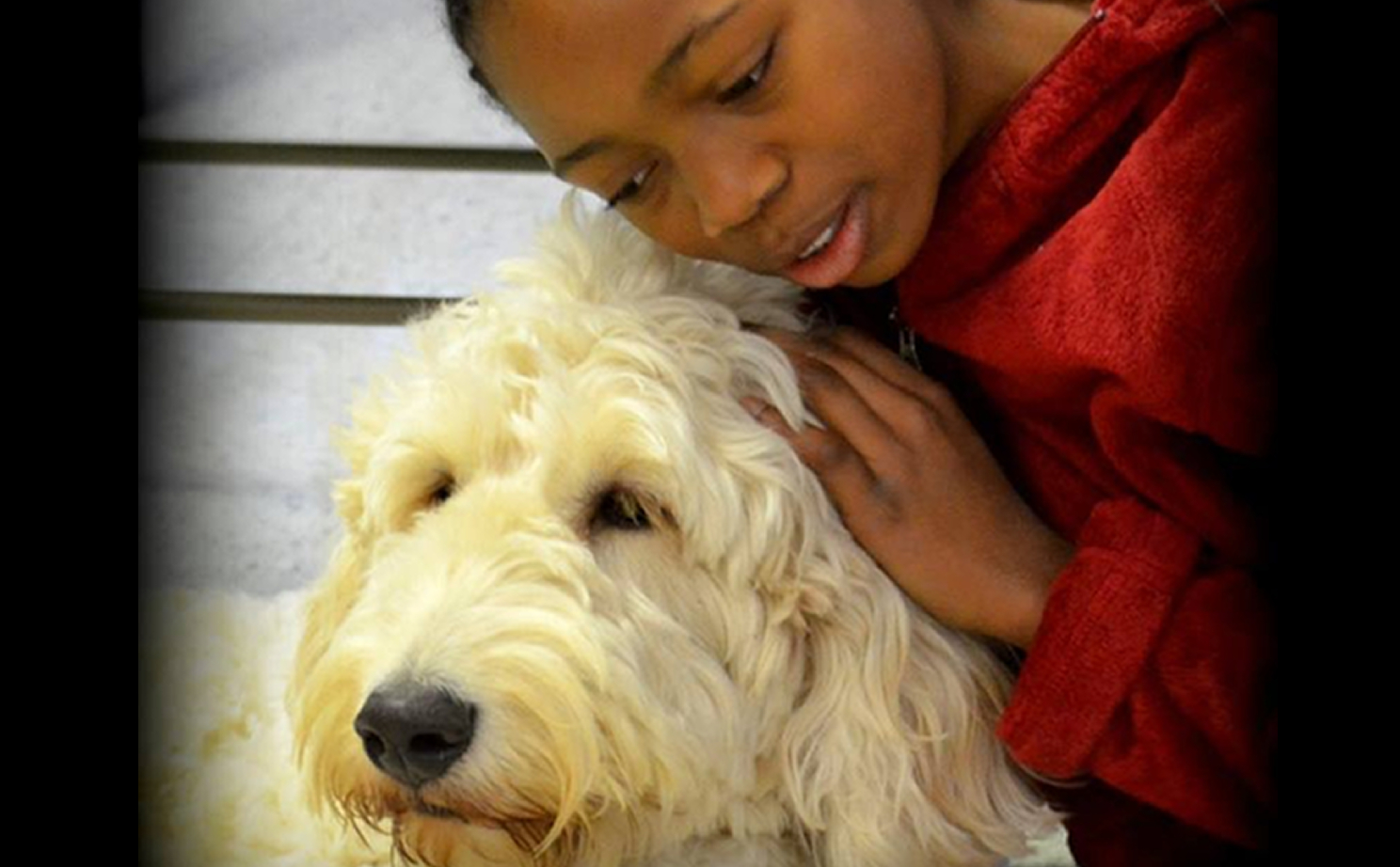
Raising children with fetal alcohol spectrum disorders (FASD) requires unconventional parenting. To discover different ways to support my son and daughter with their challenging symptoms, I stumbled upon a service dog agency that trains dogs for children and veterans. In addition to assisting children living with epilepsy, type 1 diabetes, hearing impairments, autism, cancer, and search and rescue for elopement, they train FASD assistance service dogs. I was unaware that such a service dog existed! The decision to pursue a service dog for my daughter in 2013 changed our family immeasurably.
Requirements and Fundraising
The agency we connected with does not assess the severity of a child’s disability. They required a note from our physician verifying my daughter’s disability, and after a phone interview, we were accepted into the program. We discussed the tasks for which our future dog would be trained, including behavior disruption and tethering.
Training a service dog costs over $40,000, and some agencies require client families to fundraise a substantial portion of the cost. Fundraising, even in the large city where we lived, was challenging. Our “village” assisted with creative activities, events, and personal donations. I also put flyers in my work colleagues’ mailboxes explaining how a service dog would help my daughter, including a cute photo of her with a drawing she made of her future dog.
The generosity from the community was overwhelming. Our fundraising goal was met in three months and my daughter was officially placed in the January 2015 class. It felt like forever in the future, yet the time passed quickly. We joined a Facebook group dedicated to our service dog training class which allowed us to get to know the other families that would be attending the same class. We enjoyed learning about the many dogs in training at the agency and had fun speculating which one might be ours someday.
Ned
On Christmas Eve 2014, we received an email from our agency written in our dog’s voice introducing himself to our family. It was the best present ever! His name is Ned, and he is a large, cream-colored golden doodle weighing in at 90 pounds. The photo was a shock; he was so big that I referred to him as our polar bear. I was initially stressed about his size because I am only 5’2”, yet, all of my fears vanished when we finally met Ned. He was a perfect match for my daughter.
A few days later, my adult nephew joined us on our trip to another state for a freezing winter, where we spent twelve days in service dog school. It snowed the night we arrived and didn’t melt during our stay. Walking a dog at night in -6 degrees on icy and snowy ground was a new experience for our Southern California selves. My children were excited to miss two weeks of school and my nephew helped them with their schoolwork. Fortunately, because service dogs are considered medical equipment and are protected by the Americans with Disabilities Act (ADA), their absences were excused.
During our trainings, we learned obedience commands, as well as commands for tasks related to my daughter’s disabilities, veterinary care, ADA law, exercise needs, and grooming. In addition to fetal alcohol syndrome (FAS), the most impacted form of the fetal alcohol spectrum, my daughter has an intellectual and developmental disability (IDD) and several mental health diagnoses. Because she struggles with safety awareness, she was unable to handle her dog safely on her own. Therefore, I was trained as the dog’s handler, and we became a three-member team.
On the first day of class, each family is introduced to their dog individually. We also met our dog’s primary trainer, Elena, who is from Greece. She was completing an internship with our agency. Luckily for us, the other dogs Elena was training dropped out, allowing her to focus extra attention on Ned.
Service dogs for children are trained to socialize with others when the handler and child feel comfortable. This is especially helpful for children with autism and some individuals with FASD. The dog is a social bridge. The child becomes the “cool kid” when others can enjoy fun commands like high-fives and shaking hands. Despite Ned’s size, which drew a lot of attention in public, no one was afraid of him. I allowed children who asked first to pet him if my daughter was comfortable at that moment. Children almost always asked to pet him, while adults did not!
Specialty Training
My daughter faced a number of challenges that were the focus of our dog’s training.
Anxiety
Severe anxiety, slow processing speed, and unreliable memory cause her to feel overwhelmed constantly. When intensified, this anxiety leads to severe meltdowns that can last for hours. It feels as if a switch has been flipped, causing an explosion. The triggers were numerous and unpredictable. Simply saying “no” would provoke a series of behaviors that escalated rapidly. The meltdowns were beyond my daughter’s control, resulting in her losing access to the ability to speak. She screamed, grunted, and sometimes became violent. Fortunately, she was small for her age, so the damage to people and belongings was minimal, but still remained physically and financially painful.
When I sensed a meltdown brewing, I would command Ned to lay his head on my daughter’s lap. She could then focus her attention on him and pet him. His luxurious fur was so calming to pet, and he loved it – a mutually beneficial interaction! The ‘over’ command was another helpful tool. Ned was trained to lay in her lap, providing calming deep pressure with his weight. My daughter also loved to lie on the floor on her stomach while he would lie over her back, close to her hips. As a result of these tasks, meltdowns decreased from daily occurrences to once or twice a month. There are no words to express how much this has improved our lives.
Phobias & Fears
Spider and bug phobias that began after encountering a spider in her kindergarten classroom bathroom resulted in my daughter refusing to enter any school bathroom or most public restrooms. Her phobia became so severe that when she saw a spider on the outside of our van window, she froze and couldn’t get out of the vehicle. After an hour of begging and cajoling, and after the spider was long gone, I had to grab her, cover her eyes, and drag her out of the van while she screamed in horror. Another time, after spotting a web where my son practiced soccer at the park, she refused to step foot there again for years.
Once we had Ned, his presence alone was sufficient to shift my daughter’s focus; she could pet him and focus her attention on his presence, not noticing the spiders, bugs, or other triggering elements.
Avoiding use of the bathroom all day at school grew to the point of becoming a medical emergency. Her medication could not build up in her bladder for so long without risking permanent damage. When she was picked up from school, she got into our van and cried in misery the whole drive home because she needed to go so badly.
During service dog training, we practiced at the mall going into public restrooms, where Ned was trained to go with my daughter into the stall while I waited outside. Having him there allowed my daughter to enter the restroom and continue on her own. This was extremely valuable to me. I no longer had to step away from cooking dinner to wait in the bathroom or be woken up in the middle of the night to go with her. Ned took on these responsibilities. He also would lie on the floor in the bathroom while she bathed or showered, allowing his presence to provide the felt-safety she needed to do these tasks without me having to be there. The benefits were immediate and deeply appreciated. He accompanied her to the bathroom twenty-four hours a day.
Escalators are off-limits for safety reasons, as paws can get stuck in the step grooves, so one challenge we faced was walking down stairs. (Gravity is not a large dog’s best friend!) Elena helped us problem-solve this situation and came up with a modified way for Ned to safely navigate steps.
Self-Harm
Self-harm happens when sensory overload occurs. My daughter pulled at her delicate hair, breaking it around her head, leaving a ring of very short hair that no longer fit into her protective braids. She picked at skin scabs and bit her nails and skin until it bled.
The ‘nuzzle’ command for behavior disruption and the ‘lap and over’ command for deep pressure were both trained tasks to help reduce the symptoms of FASD. I used the nuzzle command to stop her from skin picking, nail chewing, and hair pulling. Ned would approach my daughter and gently nudge her hands away from self-harming behaviors with his nose. Eventually, he learned to recognize these behaviors and nuzzle her independently. The first time Ned did this on his own, I cried in relief.
Lack of self-awareness
While she did not elope, my daughter was often unaware of danger. She rarely remembered to look before crossing the street or to stay close to me to ensure her safety. I frequently had to grab her in parking lots and at corners to keep her out of harm’s way.
In addition to the obedience commands I learned, Ned was trained in tethering as well. Service dogs always walk on the left side of their handlers. A flex cord was attached to the right side of his vest and to a strap around my daughter’s waist. With the tether, if I stopped and Ned stopped, my daughter had to stop too. We primarily used our tether in airports to navigate safely through their parking lots, crossing streets to the terminals, and moving within the terminals. It also served as a visual reminder to airport staff to be mindful of her disability.
Sleep Difficulties
Sleep issues were another challenge. She woke up multiple times during the night and wandered around the house, raising safety concerns. Although all safety precautions were in place, her relentless search for food was driven by the constant hunger caused by medication. This resulted in nightly destruction by leaving the refrigerator door open all night, resulting in much of the contents being a risk for food poisoning due to not being kept appropriately refrigerated and requiring me to throw away most of the food. I constantly found spilled food all over the kitchen counters, floor, and table.
Once we got Ned, he slept on the bed with my daughter. The comfort of having him there enabled her to relax, sleep longer, and wander less. My ability to sleep improved as much as hers did!
Service Dogs at School
I had to advocate, often with considerable frustration, for the provision of appropriate services and accommodations from our school district. The only thing they accepted without disagreement was Ned attending school. Ned was the first in our district, thanks to our superintendent’s wife, who was happy with the results of having a service dog in her district. My daughter had a 1:1 paraprofessional, which made Ned’s attendance at school possible. I spent two weeks training the paraprofessional to manage Ned. Elena even visited the school to meet the Individualized Education Program (IEP) team and share tips. Ned even had his own seat in the transport van! I commanded him to jump into the vehicle, move to his row, and I secured him with a seatbelt clip. The paraprofessional greeted them at the van when they arrived at school and cared for him most of the day. I provided a kennel for the classroom, and Ned also had a designated potty break spot arranged by the principal. Ned spent two and a half years in middle school, and it was a wonderful experience.
Raven
 When my son experienced some serious injuries that happened at our district’s non-public school placement, , he started suffering from post traumatic stress disorder (PTSD), which exacerbated his FASD symptoms. He tried to rely on Ned for his anxiety and much-needed comfort but this did not sit well with my daughter and became the cause of arguments and fighting between the children. So, I decided it was time to get a second service dog.
I contacted our agency about getting a highly trained pet dog (affectionately called fabulous flunkies). These are dogs whose temperament was not suitable for service, or they had mild medical issues. They make wonderful pets for the other children in a family that had a service dog. Since the director already knew us, she found a great match. Raven, a cream-colored golden lab mix, was a fantastic student; however, they discovered an elbow problem that required surgery, which took her out of training. Because my son was older with fewer support needs, and familiar to the director, they decided Raven was a great match. I covered the surgery expenses, and she returned to training specifically for my son. The only limit she was given was to avoid jumping from high places too often. My son taught her how to slide off furniture and use her front paws to walk herself off a bed or couch. It’s hilarious to watch! He created the command ’slide’ specifically for this skill.
Raven’s training is similar to Ned’s except for a few behavior disruption tweaks. She is not trained for tethering, and my son handles her himself in public. In June 2018, we returned to the agency for training, meeting a whole new set of families and enjoying the summer weather activities at the hotel. I felt like a pro! This time, I was able to relax and watch my son learn.
Raven was an excellent addition to our family. Raven loves to work. While my daughter had significant externalizing behaviors, my son’s behaviors were internalizing. When he was overwhelmed he would shut down, placing his head and arms on the table, tuning out the world. Raven was trained to nudge his hands and put her head close to his, shifting his nervous system shut down into a more regulated state. Raven also slept in the bed with my son, providing neuroceptive safety and proprioceptive input.
Transitions
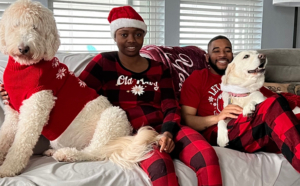 Ned retired from service in January 2025. We have completed the cycle. My son is twenty-six and no longer needs Raven for service. Since their training is similar, Raven has taken over Ned’s role. Ned has become a man of leisure unless my daughter is sick, at which point he won’t leave her side. I no longer ask him to work, and Raven is happy in her new role. Ned will spend his senior years with us. His ownership has transferred to me.
Ned and Raven changed our lives. FASD and mental illness are challenging. Along with my children, I, too, have benefited from their love and presence. In FASD, there is a phrase attributed to Diane Malbin and the book she wrote with the same title, that we should consider “trying differently rather than harder”. Service dogs are undoubtedly a “trying differently” approach that I highly recommend.
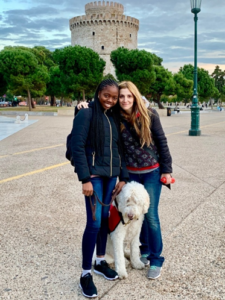 Elena, Ned’s trainer, is a well-known singer in Greece who happened to visit our hometown to perform. We see her often. She invited us to visit Greece in 2017 to promote service dogs from the American perspective. My family had a brief moment of fame when we were interviewed by television and radio stations. Doodles are rare in Greece, and Ned was a celebrity. My daughter visited senior centers with Ned and Elena, and the residents loved the doodle love.
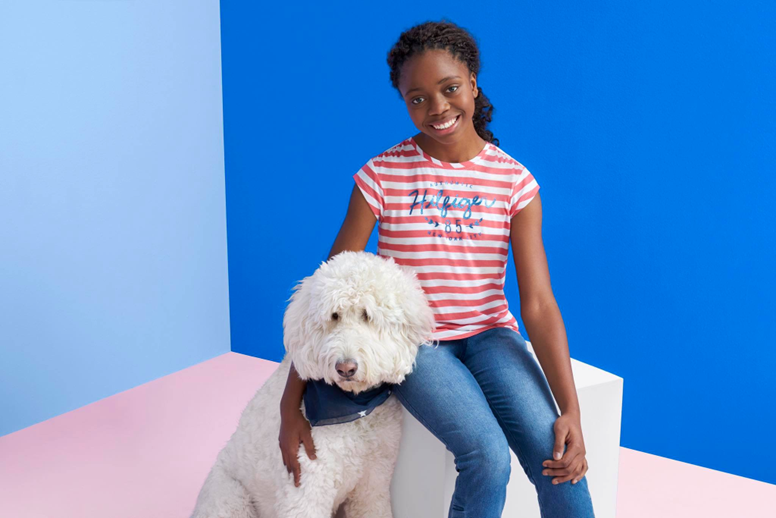 My daughter had a once-in-a-lifetime opportunity to model for Tommy Hilfiger’s Adaptive Clothing line. We flew to New York City with Ned. Ned was such a huge hit with the staff and other families that he became part of the campaign. Their photo was featured in Hilfiger stores and on the website for several months.
 Rosemary Shulman is an adoptive parent of two young adults with FASD and has navigated educational systems in multiple states. She provides educational navigation services through The Florida Center for Early Child, FASD Clinic and is passionate about coaching families to become effective medical and educational advocates for their children.